 Jay Ullrich
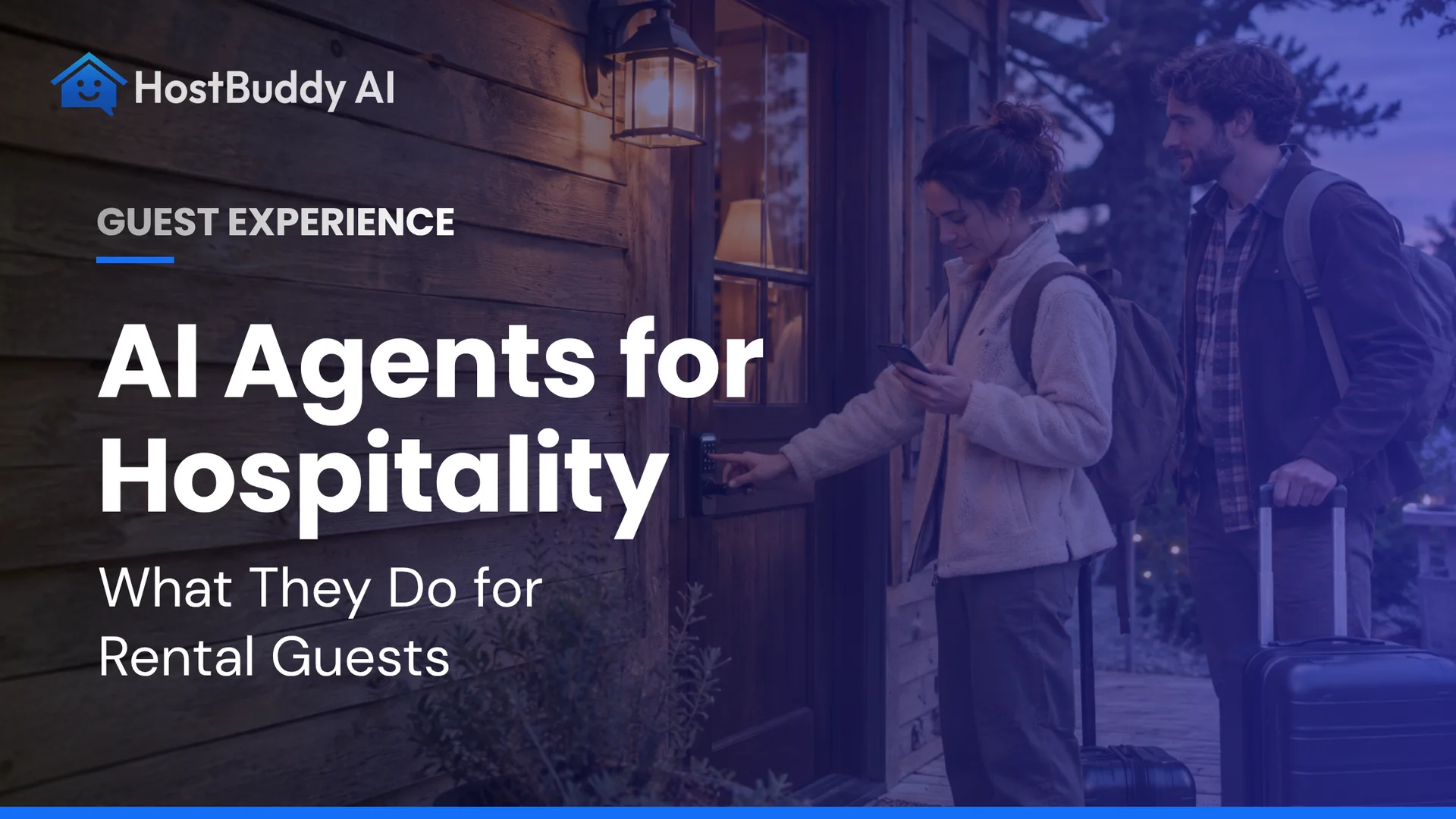
AI agents for hospitality are software systems that read guest messages, pull answers from your property's own information, take approved actions such as sending check-in details or offering a late checkout, and hand off to a person when a request needs judgment. At HostBuddy AI, we build them for short-term rentals.
Key Takeaways
- An AI agent differs from a chatbot because it works from property-specific data and live reservation context, and it can act (send, offer, escalate) instead of only replying.
- Repeatable questions such as wifi, parking, check-in, and appliance help are safe to automate; refunds, safety issues, and upset guests should stay with a person.
- Setup depends on three inputs: accurate property knowledge, written SOPs, and clear escalation triggers, all tested in a sandbox before guests see a reply.
- The strongest platform choice is one that works through your property management system and answers from each property's own information.
- Guest data deserves a deliberate policy: share access codes and sensitive details only at the journey stage that needs them, and keep payment card data out of any knowledge base.
- HostBuddy AI connects to your PMS, runs guest journeys from pre-arrival through checkout, offers upsells, and escalates exceptions to you or your team, with a 14 day free trial on all plans.
Picture 9:40 p.m. A guest asks how to work the hot tub cover, then wants to know if noon check-in is possible tomorrow, then wonders where the extra towels live. None of those questions needs you personally. All of them need an answer within minutes, or the guest starts doubting the stay.
In 2026 the useful question is no longer whether to automate guest communication but how much of it an agent can safely own. In the 2024 Hospitality Trends in the Vacation Rental Industry report, 20% of rental property managers cited automation as their primary technology challenge, according to Hostfully.
We built HostBuddy AI by hosts, for hosts, so we see this problem constantly: good properties, tired operators, and guests waiting on replies. This guide covers what agents do, how they connect to bookings, how to set one up, where to draw the line with humans, how to choose a platform, and what to ask about guest data.
What Are AI Agents for Hospitality, and How Do They Differ From Chatbots?
An AI agent for guest communication is software that reads a message in the context of a specific booking. It answers from your documented property information. It also takes defined actions, such as sending arrival instructions or flagging a problem to your team. A chatbot only matches a question to a stored reply.
The difference shows up on the first unusual question. Ask a basic chatbot whether the pool is heated and it either guesses or loops. An agent checks your property knowledge, sees the guest's dates, and answers for that listing. If the answer is missing, it escalates instead of inventing one.
Hotels have a front desk and a concierge to absorb this traffic. You have a phone. That is why we think agents matter more for short-term rentals than for most hotels: the operator is the entire guest services department. Hotel-style work still fits the same pattern. A restaurant reservation question or a maintenance request, such as a broken heater, can be answered from your documented hours and routed to the right person as an action item.
| Capability | Basic chatbot | AI agent built for rentals |
|---|---|---|
| Source of answers | Fixed FAQ list or generic model knowledge | Each property's own knowledge base, SOPs, and reservation data |
| Follow-up questions | Often loses context | Reads the whole conversation and the booking |
| Takes action | Replies only | Sends journey messages, offers upsells, creates action items |
| When it is stuck | Loops or gives a vague reply | Escalates to the host or team with a notification |
| Tone control | Rarely adjustable | Custom tone, response length, and reply delay |
We designed HostBuddy AI around the right-hand column. It works through your property management system, so each reply reflects the actual reservation and the actual property instead of a generic script.
What Can AI Agents Automate for Vacation Rental Operators?
AI agents automate the repeatable parts of the guest journey: pre-arrival questions, check-in instructions, mid-stay troubleshooting, checkout reminders, and paid add-on offers. They take the questions you have already answered a hundred times, so you only handle the exceptions.
- Pre-arrival: directions, parking, check-in time, and house rules sent on schedule.
- Check-in: door access instructions and wifi details at the moment the guest needs them.
- Mid-stay: amenity help, such as the hot tub temperature preset and soak limit your SOP spells out, or the steps to light a gas firepit.
- Checkout: departure reminders and review requests.
- Revenue: early check-in, late checkout, and gap-night offers.
- Pre-booking: a website chat widget that answers visitor questions on a direct booking site.
We cover each stage through guest journeys, and the platform has processed 40M+ messages across 25,000+ properties. Our upsell tooling can generate up to $147 per listing per month, according to our own published figure, though your results depend on your calendar and your pricing.
Our explainer on what a messaging automation tool is and how it works goes deeper on the mechanics. The AI messaging overview shows the guest-facing side.

How Does an AI Agent Work With Your Bookings and PMS?
An AI guest agent works with your bookings by connecting to your property management system and reading reservation and inquiry data in real time. It replies inside the message thread guests already use. HostBuddy AI communicates with guests directly through your PMS and pulls listing details from it once connected.
Here is a concrete flow. A guest writes, "Can we check in at noon?" The agent checks the reservation, finds your early check-in SOP, and sees whether the previous guest leaves at 11. If your rule allows it, the agent offers early check-in as a paid upsell. If not, it declines politely and offers whatever alternative your SOP lists.
Integration breadth decides how clean this is. We support 20+ integrations, including Guesty and Hostaway, and our Hostaway setup page shows what connecting looks like in practice. Channels outside your PMS, such as WhatsApp and OpenPhone, feed into the same unified inbox, so a guest who texts instead of using the platform thread does not fall through.
Speed matters because inquiries fade. Our average response time is under 30 seconds, the difference between answering a prospect while they are still on your listing and answering after they have booked elsewhere.
How Do You Set Up an AI Guest Messaging Agent Step by Step?
Setting up an AI guest messaging agent means giving it accurate property information, written rules for handling requests, and clear escalation triggers. Then you test it before guests see a single reply. Most of the work is your own documentation, not software configuration.
- Connect your PMS, or enter each property's basic information. Every property needs a name and a cover photo before you continue.
- Load the knowledge base by uploading .txt, .pdf, or .docx files, or by filling in the guided form. Files must be text-based, because image processing is not supported yet.
- Write SOPs for the rules that cost you money or sleep: early check-in, late checkout, pets, quiet hours, and refunds.
- Set tone, response length, and reply delay, then choose your auto-reply settings.
- Map the guest journey from pre-arrival through checkout.
- Run realistic guest questions through the testing sandbox.
- Switch on auto-reply for one property, read the conversations for a week, then expand with multiproperty configuration.
Be honest with yourself about step two. Automation won't fix a confusing house manual. Fix the manual first, then let the agent use it. The more complete your listing details and amenities fields are, the better the answers get. Your extras fields matter too, and past conversation learning sharpens the answers over time.
Our setup guide walks through each screen. Every plan includes a 14 day free trial, so you can start a trial and test with your own listings once your knowledge base is ready.

When Should an AI Agent Hand a Conversation to a Human?
An AI agent should hand off whenever a conversation involves safety or money. It should also hand off for access failures or an upset guest. Human handoff is a rule you write in advance that routes specific situations to a person with the full conversation attached, so the guest never has to repeat themselves.
Our recommended keep-human list is short. It includes refund and compensation requests, and anything involving gas, fire, injury, or allergies. It also covers lockouts that need a code change and complaints that hint at a review, plus any approval that costs you money. Keep refund conversations human. Automate the rest.
Good escalation passes context along. This overview of customer service tiers and escalation paths makes the same point about transferring troubleshooting history with the issue. In our setup, HostBuddy AI creates action items with notifications. Larger teams can route alerts through Slack or webhooks, and the shared inbox keeps handoffs clean when more than one person is on call.
Staff roles change rather than vanish. Instead of retyping answers, your team reviews exceptions and handles sensitive conversations. The team also improves the SOPs the agent depends on. Our best practices library goes further on escalation rules.
How Do You Choose an AI Agent Platform for Short-Term Rentals?
Choose an AI agent platform by testing six things. Check how it connects to your PMS and whether it answers from your own property data. Also test how much control you get over tone, how escalation works, whether you can test before launch, and how pricing is structured. Feature lists matter less than these behaviors.
| Criterion | Question to ask any vendor | How HostBuddy AI handles it |
|---|---|---|
| PMS connection | Does it work through your PMS or sit beside it? | Communicates through your PMS, with 20+ integrations |
| Property accuracy | Does it answer from your data? | Knowledge base, SOPs, and past conversation learning |
| Control | Can you set tone, length, and delay? | Custom tone, response length, delay, and auto-reply settings |
| Escalation | Who gets notified, and with what context? | Action items, notifications, Slack, and webhooks |
| Testing | Can you rehearse before launch? | Testing sandbox |
| Pricing clarity | Is it per property, and are there hidden fees? | Per property pricing with a 14 day free trial on all plans |
We have not verified competitor pricing, so compare vendors yourself: ask each one for a written per-property quote and what the trial includes, then set the quotes side by side with ours on the pricing page.
On build versus buy, a custom orchestrated agent only makes sense if you have developers and an unusual workflow. For most hosts and managers, buying a PMS-connected tool is faster, because maintaining prompts, integrations, and escalation logic yourself becomes a second job.
The agents that work best for short-term rental managers are built for rentals, not adapted from hotel front-desk tools, since rental questions revolve around door codes, hot tubs, parking, and house rules. Our guide to the best AI messaging app for Airbnb lays out eight criteria in more depth, and the software solutions page shows how the pieces fit. Small hosts can afford this because cost scales per property; see the pricing page for current plans, or schedule a walkthrough first.

What Results Can You Realistically Expect From AI Agents?
Realistic results are faster replies and fewer repetitive messages. You also get a larger share of your inbox handled without you, with the exact share depending on how complete your property information is. One analysis found that a full automation stack saves an estimated 7+ hours per listing per month, based on 2,248 vacation rental operators and 31,474 active integrations (Hostfully, 2026).
For messaging specifically, we report a 95%+ AI automation rate for top hosts. In one HostBuddy AI case study, an operator automated 88.5% of guest responses across 262 properties in two weeks. Those are strong results. They are not typical of a first week, and they are not a promise.
The limits are worth stating plainly:
- An incomplete knowledge base produces vague answers, so gaps in your house manual show up fast.
- Unusual requests will escalate to you; that is the design working, not failing.
- Text-based files only, since image processing is not supported yet.
- Sensitive complaints still need a human voice.
- Tone usually needs a round or two of tuning after you read real conversations.
We cover tuning habits in our tips and tricks section. Review the first week of conversations and edit your SOPs as you go; the agent improves as your documentation does.
Is Guest Data Safe With an AI Agent?
Guest data is only as safe as the platform's practices and your own habits. Any SaaS platform storing guest or owner personal data needs a clear privacy policy and, where it applies, a data processing agreement. GDPR and CCPA compliance are required for platforms handling personal data, and platforms touching payment card data must also meet PCI DSS.
Ask any vendor what data it collects, where it is stored, and who can see it. Compliance obligations vary by where you and your guests are located, so confirm requirements with the official source for your region.
Your habits matter just as much. Share door codes only at the journey stage that needs them, such as the check-in message, and not in a broad knowledge base entry that the agent could surface early. Never paste card numbers into a knowledge base or SOP. Give team members only the inbox access their role requires.
When you test in the sandbox, include a few probing questions, such as a guest asking for another reservation's details. A well-configured agent should decline or escalate.
Frequently Asked Questions
Will automated guest messages sound robotic?
They do not have to. You set custom tone and response length, and you can also set reply delay. SOPs keep answers tied to your own rules. Past conversation learning helps the agent match how you already write, and the testing sandbox lets you read replies before any guest does.
What happens when the AI can't answer a guest's question?
It escalates to you or your team instead of guessing. HostBuddy AI creates an action item with a notification. Slack notifications and webhooks are available for larger teams. Reply to the guest, then add the answer to your knowledge base so the question is covered next time.
Which property management systems does HostBuddy AI integrate with?
HostBuddy AI integrates with Guesty, Hostaway, Hostfully, Hostify, Hospitable, Lodgify, Smoobu, Hostex, Beds24, OwnerRez, Zeevou, BookingSync, Resly, and Tokeet. It communicates with guests through your PMS and pulls listing and reservation details once connected. The FAQ page has current integration notes.
Does it support guests who do not speak English?
HostBuddy AI offers global language support, so you can serve guests who do not write in English. Write your key SOPs in clear, simple language. Then run a few non-English test conversations in the sandbox. Keep sensitive escalations with a person who can follow up.
Is there a free trial, and how is it priced?
Every plan includes a 14 day free trial. Pricing is per property per month, so cost grows with your portfolio, and annual billing offers 2 months free. Current plan details are on the pricing page.
Can automated messaging help me earn more from each stay?
Yes, within limits. The agent can offer early check-in and late checkout when your SOP allows it and your calendar supports it. The same goes for gap nights. You set the rules, and no revenue outcome is guaranteed.
Can an AI agent handle WhatsApp messages and website visitors?
Yes. WhatsApp and OpenPhone connect into a unified inbox, and an embeddable chat widget answers pre-booking questions on direct booking websites. Visitors get answers while they are still deciding, which helps conversion.
What Is the Practical Takeaway for Your Rentals in 2026?
AI agents for hospitality earn their place when they answer from your own property information, act inside your booking system, and know when to step aside. Start with the repeatable questions, keep refunds, safety, and upset guests human, test everything before launch, and ask hard questions about guest data. In 2026 and beyond, the operators who document their properties well will get the most from every agent they adopt.
If you want to see guest journeys and escalation working with your own listings, HostBuddy AI gives you a 14 day free trial on every plan. Connect your PMS and load your property information. Test replies in the sandbox, then turn on auto-reply when you trust what you read. Start Free Trial and let the routine questions run while you keep the exceptions.
Content powered by inkSTR.co